

INDIA–CANADA RESET
INDIA–CANADA RELATIONS:RESET, THAW, AND THE ROAD AHEAD
“Prime Minister Carney has not even completed one year in office, yet our relations have leapt forward by a light year. I give the entire credit for this increasing momentum to my friend, Prime Minister Carney.”
— Prime Minister Narendra Modi, Joint Press Statement, Hyderabad House, New Delhi, 2 March 2026
Introduction
The India-Canada bilateral relationship entered its most severe crisis in post-independence history in September 2023, when then-PM Justin Trudeau publicly alleged in Parliament that Indian government agents were 'potentially' linked to the killing of Khalistani separatist Hardeep Singh Nijjar in Surrey, British Columbia on 18 June 2023. India categorically and repeatedly rejected the accusation, describing it as 'absurd' and 'politically motivated.' The resulting diplomatic expulsions — six Indian diplomats from Canada and an equal number of Canadian diplomats from India in October 2024, including High Commissioners — reduced the bilateral relationship to its lowest point since diplomatic ties were established 79 years ago.
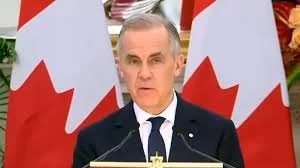
When Canadian Prime Minister Mark Carney took the stage at the World Economic Forum in Davos, Switzerland on 20 January 2026, he delivered what many observers — and subsequently the New Delhi diplomatic circuit — would describe as the philosophical foundation for Canada's bilateral reset with India. Titled 'Principled and Pragmatic: Canada's Path,' the address was not merely an economic policy statement but a geopolitical manifesto: a declaration that the rules-based international order had 'ruptured,' and that middle powers had no choice but to act together or face subordination to great power hegemony.
Carney's Davos speech was, in part, a direct response to Trump: 'Washington has changed. There is almost nothing normal now in the United States.' His call for middle-power coalitions, trade diversification, and strategic autonomy was explicitly framed as the answer to US unilateralism. India — with its large market, energy demand, and own experience of US secondary sanctions — became the most important pillar of this diversification strategy.
“In a world of great power rivalry, the countries in between have a choice: to compete with each other for favour, or to combine to create a third path with impact. We are calibrating our relationships so their depth reflects our values.”
— PM Mark Carney, Davos, January 2026 — the framework that made New Delhi possible
The single most powerful catalyst for the India-Canada rapprochement has been Donald Trump's return to the White House in January 2025 and the subsequent disruption of the US-led trade and security order. For both India and Canada — countries with very different relationships with the United States — Trump's unilateralism created a shared vulnerability that transformed bilateral diplomacy from desirable to urgent. Trump's repeated references to Canada as a potential '51st state' of the United States, and his dismissive response at Davos to Carney's middle-powers speech ('Canada only lives because of the United States; watch your words') made Canada's strategic vulnerability undeniable.
