

❋
Welcome to the BRICS Institute, India!
Welcome to the BRICS Institute, India!
Our TIME has Come.
Let me begin with a simple observation: our time has come. The time of the Global South has come.the future world order will be very much what we are going to see at the 18th BRICS Leaders summit in New Delhi. It is already the half of the world.
The old order is exhausted. We have just watched the United States fight what may be its last major war of choice in the old style in Iran. The world has seen, once again, the limits of coercion as a strategy. This is not a moment for triumphalism. It is a moment for clarity. The post-Cold War unipolar system has brought increased conflict and greater inequality to the world. BRICS seeks to correct this imbalance by building a new cooperative and just global order based on equality, respect and constructive collaboration. The century ahead will not be written by any single power. It will be written by nations like ours, working together, on our own terms.
The Extended BRICS bloc provides the roadmap to a multipolar global system based on increased international collaboration, expanded South–South cooperation and a vision for a new global order informed by the Bandung spirit, anti-colonisation and anti-imperialism.
What we need to implment is Honesty in Our bilateral relations. If we are to build that future, we must start with honesty — honesty in how we deal with one another bilaterally, we must deal with honesty about where we complement each other rather than compete.
Nowhere is this truer than in the relationship between India and China. Taken as a whole, India-China cooperation is a win-win proposition. Two civilizations, two of the world's largest economies, two anchors of the Global South ‚when we work together, the whole world benefits. When we allow ourselves to be pulled apart, only third parties gain. As once chinese leader Xi remarked: wehen india and chian speak together the whole worl listends.
We have, frankly, already tasted the bitterness of alternative arrangements. The Indo-Pacific construct, the Quad‚ these have not delivered the security or prosperity they promised. They have delivered division. The Global South does not need to be organized into blocs against itself. It needs India and China working together, and it needs the rest of us building on that foundation.
So here at brics 2026 forum India calles for resisting division, choosing unity. Let us be candid, the West is doing everything it can to derail BRICS cooperation. That should not surprise us, and it should not deter us. Our answer is not confrontation ‚it is unity. We must work for global justice and the sovereign equality of all nations, strengthen multilateralism, and create a peaceful atmosphere in which every nation, large and small, can pursue its own development.
Let me talk in brief about India's Vision for Its BRICS Presidency.
As the theme of India's presidency of BRICS in 2026, we have chosen a people-centered approach ‚ a humanity-first approach. This means sharing the benefits of growth with all, not just a few. It means promoting innovation across the Global South, not confining it to the boardrooms of the old industrial powers.
Our people, our cultures, our civilizations, our diversity ‚ these are not obstacles to unity. They are our strength. And in an era of competing systems, we believe the Five Principles of Panchsheel ‚ mutual respect for sovereignty and territorial integrity, non-aggression, non-interference, equality, and peaceful coexistence ‚ remain our best and most enduring contribution to global diplomacy.
At this summit India’s call for Reforming Global Governance is the key to our deliberations.
The institutions built in the aftermath of the Second World War no longer reflect the realities of the twenty-first century. The United Nations must be reformed. The IMF and the World Bank must be restructured to reflect the true weight and voice of the nations they claim to serve. This is not a request — it is a necessity if these institutions are to remain relevant.
At the same time we must emhasize our Shared Responsibilities for global problems such as climate change. Continued BRICS cooperation and the expansion of this multilateral forum hold great promise for a new, more peaceful, prosperous and productive world order.
Even as we pursue this positive agenda, we must be equally united against the threats that endanger all our societies: terrorism in all its forms, the trafficking of human beings and narcotics across our borders, illicit financial flows, and illegal cross-border trade. No nation can fight these alone. They demand the same solidarity we bring to our economic and diplomatic cooperation.
Let me Conclude with the hope that this forum will go down as historical for the rise of global south and will lay down the blueprint for a more just and equitabel world order. Let us work, together, for a shared future for humanity ‚a future built not on domination, but on partnership; not on division, but on justice; not on the interests of a few, but on the dignity and development of all. The BRICS project is thus a critical component of humanity’s quest for lasting international peace, stability and prosperity.
Thank you for reading.
The Expanded BRICS Architecture
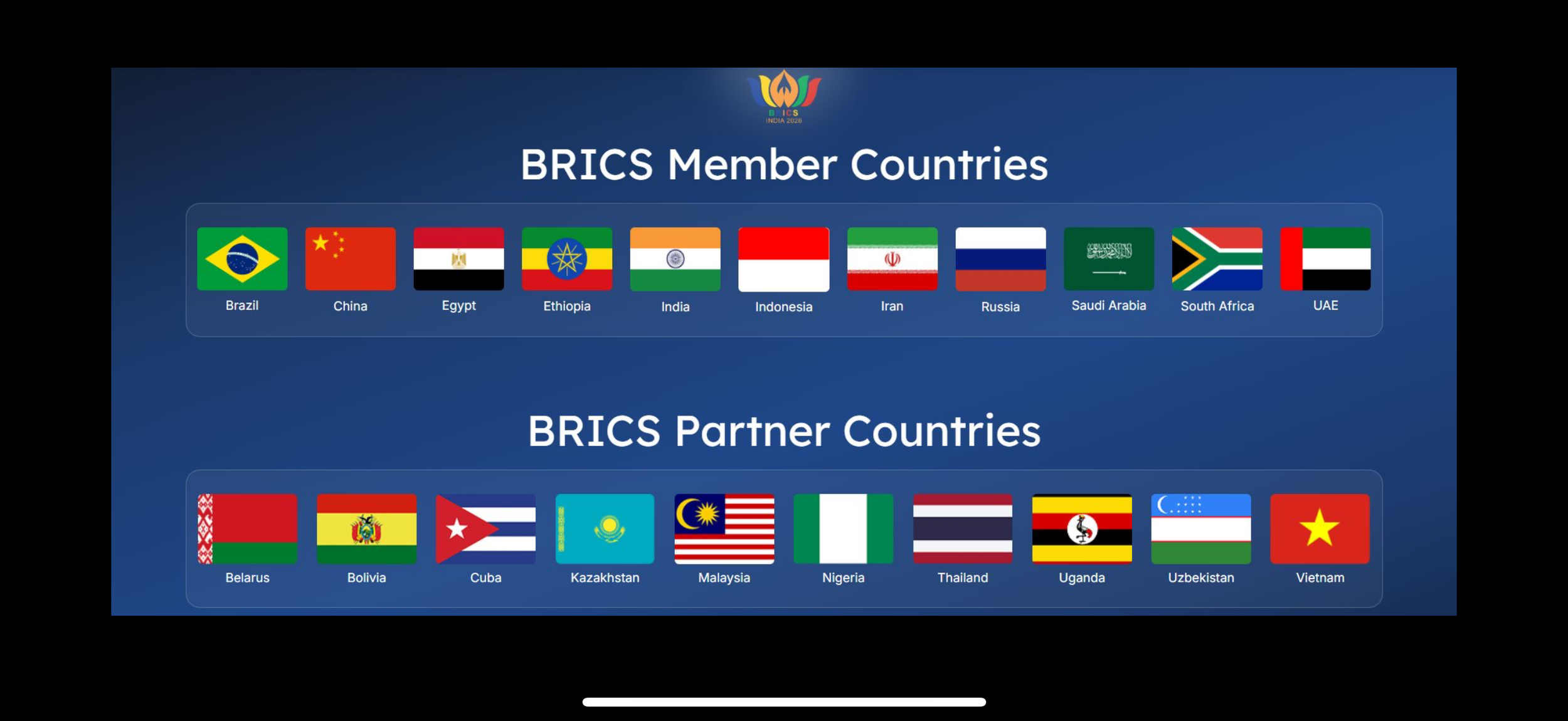
India assumed the rotating BRICS chairship on 1 January 2026, its fourth such tenure after 2012, 2016, and 2021. The bloc now comprises 11 full members — Brazil, China, Egypt, Ethiopia, India, Indonesia, Iran, Russia, Saudi Arabia, South Africa, and the United Arab Emirates — together with 10 partner countries that joined in January 2025: Belarus, Bolivia, Cuba, Kazakhstan, Malaysia, Nigeria, Thailand, Uganda, Uzbekistan, and Vietnam. Four additional countries — Algeria, Nigeria, Turkey, and Vietnam — were invited as partner countries at the Kazan Summit in October 2024 but had not formally confirmed their status as of early 2025.
The expansion of BRICS to 21+ countries, including multiple European-adjacent states (Belarus, Turkey, Kazakhstan, Uzbekistan), and the growing informal dialogue between BRICS members and European institutions, represents a qualitative shift in the bloc's character. Several European countries — including Hungary, Serbia, and Slovakia — have expressed sympathy with the BRICS approach to multipolar governance. The EU's collective position remains opposed to its member states joining BRICS, but the political heterogeneity within the EU means this consensus is not immovable.
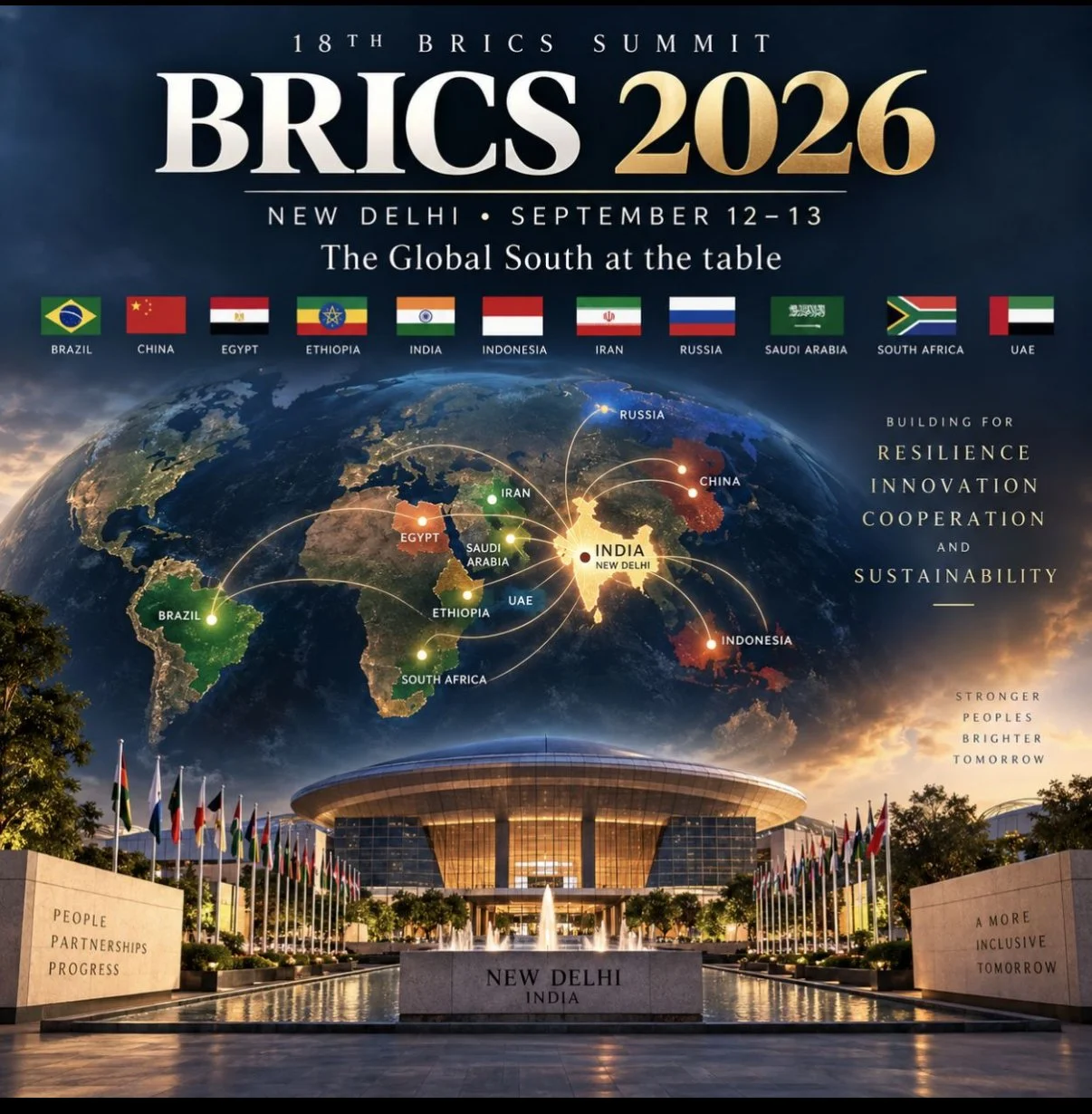
India's presidency is guided by the theme 'Building for Resilience, Innovation, Cooperation and Sustainability' (BRICS) — a deliberate restatement of the bloc's own acronym. Prime Minister Modi's Humanity First framework positions India as a bridge between the Global South and Western-aligned institutions, emphasising that BRICS is a forum for inclusive development, not a confrontational anti-Western coalition. BRICS India 2026 has explicitly positioned the bloc as a bridge between the Global South and Western institutions.
Proposal for a 'BRICS European Dialogue Partner' Framework
India's BRICS presidency should table a proposal for a European Dialogue Partner category — formally inviting select European-adjacent states (Turkey, Serbia, Georgia, and potentially Hungary) to engage with BRICS on multilateral governance reform, climate finance, and development finance agendas where European and BRICS interests converge. This positions BRICS as a genuinely multipolar platform, not a China-Russia bloc, and directly serves India's stated Humanity First and Vasudhaiva Kutumbakam framing.
The 2026 BRICS Civil Council should recommend to the Indian BRICS Sherpa track (chaired by Secretary Sudhakar Dalela) that a dedicated BRICS-India-Europe diplomatic dialogue be initiated especially for the European nations. This proposal of creating a European Dialogue Partner concept would formally invite select European states — Turkey, Serbia, Hungary, and potentially others — to engage with BRICS on specific multilateral governance reform agendas (UNSC reform, IMF voting share reform, WTO reform, climate finance) where European and BRICS positions converge, without requiring those countries to choose between their European/NATO identities and BRICS engagement.
The Civil Council's role is to create the informal diplomatic space — through BRICS Think Tank Council, Civil Forum, and Academic Forum channels — in which such a reset can be prepared before formal government-to-government engagement. The inaugural BRICS European Dialogue Forum — potentially hosted in New Delhi, given its unique civilisational bridge position — would signal BRICS's post-confrontational character, create direct engagement with major European econmies and thus enhance the role of BRICS in creating a new Multipolar world order which is not based on binary considerations.
Think Future! Think BRICS!
Think Future! Think BRICS!
India assumed the rotating chairmanship of BRICS on January 1, 2026, taking over from Brazil. This marks India’s fourth tenure as chair after 2012, 2016, and 2021. During its presidency, India will host the 18th BRICS Summit later in 2026, along with an extensive calendar of ministerial and sectoral meetings covering commerce, connectivity, technology, fintech, education, counter-terrorism, climate action, and sustainable development.
The official theme of India’s BRICS 2026 chairship is “Building for Resilience, Innovation, Cooperation and Sustainability,” reflecting a people-centric, humanity-first approach articulated by Prime Minister Narendra Modi. The theme emphasizes inclusive growth, shared responsibility, and collective solutions to global challenges. Together, they form the foundation of India’s vision for a more balanced, equitable, and future-ready BRICS framework.
The annual BRICS summits play a crucial role in driving the group's mission forward and strengthening cooperation among its member states. Each summit often unveils new partnerships, working groups, or joint ventures. The whole process of summit meetings sometime lasts for a week time, which is like mini–United Nations. The 2024 Russian chairmanship of BRICS hosted more than 200 meetings and cultural events with participation from 40 plus countries including non-BRICS members. This is being seen as largest gathering of leaders form global south to deliberate on challenges and find some common solutions. In 2025, Brazil hosted another round of expanded leaders summit where whole global south was present. this year it is India’s responsibility to take forward BRICS mechanism to become an institutionalized global institution and not just a discussion group.
Geopolitically, India’s BRICS chairship is positioned as a stabilizing and consensus-building effort within an increasingly multipolar world. India has emphasized South-South cooperation, reform of global governance institutions, poverty alleviation, climate transition, and development financing, while avoiding confrontational postures. With an expanded BRICS membership, India’s approach focuses on inclusivity, flexibility, and institutional cohesion, ensuring that BRICS remains effective despite its growing diversity.
A key emerging focus under India’s presidency is financial innovation, particularly the proposal to link BRICS central bank digital currencies. Other priorities expected to shape discussions include trade facilitation in national currencies, infrastructure development, sustainable finance, technological collaboration, education and skills exchange, and stronger people-to-people ties. India has also reiterated the need for reforms in multilateral institutions such as the United Nations Security Council, the IMF, the World Bank, and the WTO, so that global decision-making structures better reflect contemporary economic and geopolitical realities.
This year, under the aegis of the BRICS Civil Council, we are organizing a series of roundtables and a major conference in New Delhi, focusing on issues like global governance, health, digital cooperation, and sustainable development. We expect a strong delegation from civil society and think tanks of all the BRICS Member countries.As preparations for the 18th BRICS Summit continue, India’s presidency is expected to deliver a forward-looking agenda that balances strategic ambition with practical cooperation. BRICS India 2026 seeks to reinforce the grouping’s role as a credible platform for the Global South, capable of shaping global discourse on development, resilience, and sustainable growth in the 21st century. For official updates and developments, the BRICS 2026 website, http://brics2026.gov.in, serves as the central reference point.
In the current global crisis and deinstitutionalization, Civil society organizations across the spectrum are facing sever challenges of funding and legitimacy. on the one hand they are simultaneously called upon to fill governance gaps left by weakening institutions, while facing growing constraints on funding, mobility, and political legitimacy. on the other hand they are denied basic funding and political cal support to carry out their stated mission. In this context, the role of independent media, civic networks, and international civil society platforms becomes critical—not as alternative centres of power, but as mechanisms of accountability, social resilience, and cross-border dialogue. In this context BRICS Civil forum in India will hold a significant forum for global civil society organizations. keep watching these spaces for more details.
वर्तमान वैश्विक संकट और संस्थागत शिथिलता के दौर में, नागरिक समाज के विभिन्न संगठनों को वित्तपोषण और वैधता संबंधी गंभीर चुनौतियों का सामना करना पड़ रहा है। एक ओर तो उन्हें कमजोर होते संस्थानों द्वारा छोड़े गए शासन संबंधी अंतरालों को भरने का आह्वान किया जा रहा है, वहीं दूसरी ओर वित्तपोषण, गतिशीलता और राजनीतिक वैधता पर बढ़ते प्रतिबंधों का सामना करना पड़ रहा है। वहीं दूसरी ओर, उन्हें अपने घोषित मिशन को पूरा करने के लिए बुनियादी वित्तपोषण और राजनीतिक समर्थन से वंचित किया जा रहा है। इस संदर्भ में, स्वतंत्र मीडिया, नागरिक नेटवर्क और अंतर्राष्ट्रीय नागरिक समाज मंचों की भूमिका महत्वपूर्ण हो जाती है - वैकल्पिक सत्ता केंद्रों के रूप में नहीं, बल्कि जवाबदेही, सामाजिक लचीलेपन और सीमा पार संवाद के तंत्र के रूप में। ब्रिक्स की भारत की अध्यक्षता खाद्य एवं ऊर्जा सुरक्षा, जलवायु परिवर्तन और डिजिटल परिवर्तन, स्टार्टअप्स, नवाचार और मज़बूत विकास साझेदारी के माध्यम से सतत विकास पर केंद्रित होगी। विदेश मंत्री जयशंकर ने न्यूयॉर्क में ब्रिक्स विदेश मंत्रियों की बैठक की मेज़बानी की। उन्होंने ज़ोर देकर कहा कि ब्रिक्स को संयुक्त राष्ट्र सुरक्षा परिषद में सुधारों के अपने "सामूहिक आह्वान" को और मज़बूत करना चाहिए। इसी संदर्भ में, भारत में आयोजित ब्रिक्स फोरम वैश्विक नागरिक समाज संगठनों के लिए एक महत्वपूर्ण मंच होगा। अधिक जानकारी के लिए इन स्थानों पर नज़र रखें।