

India and the Post-Western World Order
INTERNATIONAL RELATIONS — WORKING PAPER 260301
Title; After Western Hegemony:
India’s Civilisational Imperative and the Architecture
of a Cooperative, Multipolar World Order
Abstract
The post-1945 liberal international order, constructed under the aegis of American hegemony and shaped by the strategic imperatives of Western capitals, is undergoing a structural rupture of historic proportions. The convergence of great-power revisionism, the delegitimisation of Western-led institutions, the emergence of a multipolar economic landscape, and the vocal assertion of the Global South collectively herald the end of an era. This paper examines the contours of the emerging world order, advances a theoretical framework for its architecture, and argues that India — by virtue of its civilisational wisdom, democratic credentials, demographic dividend, and accelerating economic weight — is uniquely positioned to lead the Global South toward a cooperative, fair, and representative multilateral system grounded in international law. The paper identifies decisive policy choices India must make during this interregnum — choices that will determine whether the transition is managed peacefully or descends into systemic disorder. Drawing on structural realism, postcolonial international theory, and constructivist insights, it situates India’s rise not merely as a function of power maximisation but as a normative project: the realisation of Vasudhaiva Kutumbakam — the world as one family — as a governing philosophy for a post-Western international order.
Keywords: Multipolarity · India · Global South · Post-Western Order · Multilateralism · Demographic Dividend · BRICS · Strategic Autonomy · Civilisational Realism · International Institutions
I. Introduction: The Interregnum and its Stakes
The old world is dying and the new world struggles to be born; now is the time of monsters. But in the right hands, the interregnum is also the time of architects.
— Antonio Gramsci, adapted for the contemporary moment
Antonio Gramsci’s celebrated dictum — that the old world is dying and the new world struggles to be born, and that in this interregnum a great variety of morbid symptoms appear — has found renewed analytical resonance in the international relations scholarship of the mid-2020s. The structural conditions that sustained the post-Cold War unipolar moment have eroded with unusual velocity. The United States, architect and guarantor of the rules-based international order, has itself become an unreliable patron: weaponising the dollar, withdrawing from multilateral compacts, threatening territorial annexations of allied nations, and subordinating the liberal internationalist covenant to transactional mercantilist calculus.
It was against this backdrop that Mark Carney, Prime Minister of Canada and former Governor of the Bank of England, delivered what many observers characterised as a watershed address at the World Economic Forum in Davos in January 2026. Speaking to an audience of heads of state and global business leaders, Carney declared: “We are in the midst of a rupture, not a transition. It is the end of a pleasant fiction and the dawn of a brutal reality — where great-power geopolitics is submitted to no limits, no constraints.” The speech received a standing ovation, a rare occurrence at the staid Davos forum. Its significance lay not merely in its rhetorical power but in its source: a former central banker and liberal institutionalist, one of the most credible voices of the existing order, was publicly confessing its structural failure.
The rupture Carney described is real, measurable, and accelerating. The three vectors of this rupture are identifiable. First, the order failed ‘by design’: asymmetric trade rules, selective application of international law, and the structural embedding of Western dominance within ostensibly universal institutions created what postcolonial scholars have long described as the paradox of formal equality and substantive hierarchy. Second, the order has been dismantled ‘by wrecking ball’: the Trump administration’s systematic use of tariffs as geopolitical instruments, its threats of annexation and financial coercion, and its contemptuous dismissal of multilateral norms have stripped the order of its normative pretence. Third, and most consequentially for our purposes, the order has been abandoned ‘by confession’: the high priests of liberal internationalism now acknowledge what the Global South has argued for decades — that the system was designed to serve the powerful.
The question before international relations theory and policy is therefore not whether the post-Western world is coming, but what kind of world will fill the void, who will lead the construction of its institutions, and on what normative foundations they will rest. This paper advances the argument that India — not as an aspirant hegemon seeking to replicate Western dominance under a different flag, but as a civilisational democracy with structural advantages uniquely suited to the transitional moment — is the indispensable architect of a new cooperative order. The remainder of this paper is structured as follows. Section II diagnoses the structural decline of the Western-led order. Section III examines the character of the emerging multipolar landscape. Section IV articulates the normative framework of the new order India should champion. Section V analyses India’s structural advantages — demographic, economic, civilisational, and institutional. Section VI identifies the decisive policy choices of the interregnum. Section VII concludes.
II. Structural Decline of the Western-Led Order: A Diagnostic
2.1 The Legitimacy Deficit
The post-1945 international order rested on three pillars: coercive capacity concentrated in American military and financial power; institutional architecture embedded in the United Nations, Bretton Woods institutions, and the GATT/WTO system; and ideological legitimacy grounded in the promise of universal norms, human rights, and the rule of law. Each of these pillars has experienced significant erosion across the first quarter of the twenty-first century.
The legitimacy deficit is perhaps the most consequential dimension of the crisis. The selective application of international law has progressively hollowed out the normative foundations of the Western-led order. The invasion of Iraq in 2003 without UN Security Council authorisation; the NATO intervention in Libya in 2011 that exceeded its mandate; the consistent shielding of Israel from accountability under international humanitarian law despite International Court of Justice and International Criminal Court proceedings; and the asymmetric enforcement of sanctions regimes have collectively produced what Reus-Smit (2004) terms a ‘crisis of legitimation’ — a condition in which the rule-makers are perceived, with justification, as exempt from their own rules.
The Global South’s grievance is not with multilateralism as such but with the particular multilateralism it has experienced: one in which the UN Security Council’s veto architecture preserves the privileges of 1945, in which the IMF’s conditionality imposes fiscal austerity on developing nations while Western economies engage in unlimited quantitative easing, and in which the WTO’s agricultural subsidy regime systematically disadvantages small farmers in the developing world. As Amitav Acharya (2014) has argued, the post-Western world is not an anti-order world; it is a demand for a ‘world of worlds’ — a genuinely multiplex system that incorporates diverse civilisational contributions to international norms.
2.2 The Power Transition and its Discontents
Power transition theory, originating in Organski’s (1958) seminal formulation and refined through decades of scholarship, posits that hegemonic wars are most likely when a rising power approaches parity with the dominant power. The China-United States dyad has generated substantial scholarly anxiety in this regard, with Allison’s (2017) ‘Thucydides Trap’ framework achieving particular public salience. However, the current transition is structurally distinct from previous hegemonic transitions in several respects.
First, the transition is genuinely multipolar rather than bipolar. China’s rise is the most visible element of the power shift, but the emergence of India, the expanding weight of ASEAN collectively, the reassertion of Turkish regional ambitions, and the consolidation of BRICS+ as a geopolitical framework collectively suggest a diffusion of power across multiple poles rather than a simple transfer from one hegemon to another. The IMF projects that by 2030, four of the world’s five largest economies by purchasing power parity will be non-Western: China, India, Japan — an ageing outlier — and Indonesia.
Second, the transition is occurring simultaneously across multiple domains — military, economic, technological, and normative — at unprecedented speed. The BRICS+ grouping, expanded in 2024 to include Egypt, Ethiopia, Iran, the UAE, Saudi Arabia, and Indonesia, now represents over 35% of global GDP (PPP), 46% of world population, and controls critical mineral supply chains essential to the clean-energy transition. The group’s New Development Bank has disbursed over $35 billion in infrastructure lending without the conditionality attached to Western-led institutions. The BRICS Pay system represents a nascent but serious challenge to the dollar’s settlement function, prompting former President Trump to threaten 100% tariffs on any nation pursuing de-dollarisation — a response that inadvertently confirmed the seriousness of the challenge.
Third, and crucially, the transition is normatively contested. Unlike the transition from British to American hegemony in the mid-twentieth century — a handover between two polities sharing fundamental ideological commitments to liberal capitalism — the current transition involves actors with sharply divergent conceptions of sovereignty, human rights, the relationship between the state and the individual, and the legitimate use of force. This normative contestation is the central challenge of the interregnum, and it is here that India’s distinctive contribution becomes analytically indispensable.
2.3 Institutional Paralysis: The Crisis of Multilateralism
The multilateral system erected after 1945 faces a crisis of functionality that compounds its crisis of legitimacy. The UN Security Council has been paralysed on Ukraine, Gaza, Sudan, and the Korean Peninsula by the mutual veto of permanent members. The WTO’s Appellate Body has been rendered non-functional since 2019 by the United States’ refusal to approve new appointments — a unilateral act that has effectively suspended the binding dispute settlement mechanism at the heart of the multilateral trading system. The G20, which demonstrated its potential as a crisis management forum in 2009, has been progressively deadlocked as Russia and China resist language on Ukraine and the West resists language on Palestinian rights and climate financing.
The specific crises of the current moment — the ongoing conflict in Ukraine, the humanitarian catastrophe in Gaza, the Taliban’s systematic erasure of women from public life in Afghanistan, and the democratic backsliding and debt crises of Latin America — share a common structural feature: none of them can be resolved by the existing multilateral architecture because that architecture is internally divided along the very geopolitical fault lines the crises embody. The world requires new institutions, reformed existing institutions, and, above all, a new political entrepreneur willing to invest the diplomatic capital to build them.
III. Contours of the Emerging World Order
3.1 The Multiplex World: Beyond Polarity
The scholarly literature offers several competing frameworks for conceptualising the post-unipolar order. Ikenberry’s (2011) liberal internationalist perspective anticipates a ‘liberal leviathan’ in modified form, acknowledging that American hegemony must become less imperial and more cooperative to survive. Mearsheimer’s (2001) offensive realist framework anticipates intensifying great-power competition culminating in a bipolar confrontation between Washington and Beijing. Buzan and Acharya’s ‘world of worlds’ or ‘multiplex world’ framework offers a more nuanced analysis, positing that the emerging order will be genuinely plural: shaped by multiple regional powers, driven by functional interdependence, and characterised by overlapping and competing normative frameworks rather than a single hegemonic ideology.
This paper endorses the multiplex framework as descriptively superior, while arguing that it requires normative supplementation. A multiplex world without cooperative institutional architecture is simply a return to the anarchic self-help system of pre-1914 great-power politics — with the additional catastrophic risk of nuclear weapons, climate change, and AI-enabled conflict. The imperative of the transitional moment is therefore not merely to describe multipolarity but to institutionalise it: to build the rules, norms, and organisations that can manage competition, facilitate cooperation on global commons, and guarantee the security and development rights of smaller states in a world without a single hegemonic guarantor.
3.2 The Normative Architecture of the New Order
The new order must rest on five normative pillars if it is to be stable, just, and capable of addressing the collective action problems of the twenty-first century. These pillars are not novel inventions; they are the unrealised promises of the existing order, stripped of their selective application and genuinely universalised.
i. Genuine Sovereign Equality: The principle of sovereign equality, enshrined in Article 2(1) of the UN Charter, must be operationalised beyond its rhetorical affirmation. This requires structural reform of the UN Security Council to reflect contemporary power distributions, reform of the IMF and World Bank voting structures, and an end to the weaponisation of financial architecture (SWIFT exclusions, secondary sanctions) as instruments of unilateral coercion.
ii. Non-Conditionality in Development Finance: The New Development Bank model — lending for infrastructure and development without the political conditionality attached to IMF-World Bank programmes — must be scaled and institutionalised. Development financing that respects national policy space while maintaining environmental and social safeguards represents a viable middle path between the Washington Consensus and the infrastructure-for-influence model.
iii. Proportionate Representation in Global Governance: International institutions must reflect the contemporary distribution of economic and demographic weight. The exclusion of the African Union from the G20 until India’s G20 presidency in 2023, despite Africa’s 1.4 billion people, was an anachronism that India corrected. The broader principle must be extended: Asia, Africa, and Latin America collectively must hold voting shares in international institutions commensurate with their share of the world economy and population.
iv. Universality of International Law: The selective enforcement of international law — enforced against adversaries, waived for allies — is the single greatest source of Global South cynicism about the existing order. A new order must commit to the genuine universality of international humanitarian law, the jurisdiction of the ICJ and ICC, and the non-weaponisation of economic interdependence.
v. Cooperative Security and Conflict Prevention: The failures of the existing order in Ukraine, Gaza, Afghanistan, and Sudan share a common thread: the absence of functioning regional security architectures capable of early prevention. The new order must invest in regional security institutions with genuine peacekeeping capacity, funded multilaterally and governed by regional consensus.
IV. What India Teaches the World: Civilisational Contributions to International Order
4.1 Vasudhaiva Kutumbakam and Relational Multilateralism
India’s philosophical contribution to the theory of international relations has been systematically underappreciated in the predominantly Western-generated IR literature. The ancient Sanskritic concept of Vasudhaiva Kutumbakam — ‘the world is one family’ — drawn from the Maha Upanishad, represents a normative framework for international relations that is neither the self-interested anarchy of Hobbesian realism nor the hegemon-dependent order of liberal institutionalism. It posits a relational ontology — that entities are constituted through their relationships rather than existing as pre-social atoms pursuing interest in a structural vacuum — that resonates deeply with contemporary constructivist IR theory.
This is not mere philosophical ornament. India chose Vasudhaiva Kutumbakam as the official motto of its G20 presidency in 2023 under the theme ‘One Earth, One Family, One Future.’ The selection was deliberate: it signalled India’s intention to frame its multilateral leadership not in the language of interest-balancing but in the language of shared humanity and interdependence. The practical consequences were substantial: India successfully negotiated a consensus G20 Leaders’ Declaration despite deep divisions over Ukraine, successfully advocated for the African Union’s permanent membership, and launched the Voice of the Global South Initiative, convening 125 developing nations to articulate a common agenda.
4.2 Panchsheel and the Doctrine of Non-Interference
India’s 1954 Panchsheel agreement with China articulated five principles of peaceful coexistence — mutual respect for territorial integrity, mutual non-aggression, mutual non-interference in internal affairs, equality and mutual benefit, and peaceful coexistence — that became foundational to the Non-Aligned Movement and remain, in modified form, the preferred normative framework of the Global South for inter-state relations. The principle of non-interference, often dismissed in Western IR discourse as a shield for authoritarianism, reflects a genuine historical experience: the experience of colonised peoples for whom interference — invariably by more powerful external actors — meant dispossession, exploitation, and violence.
India’s task in the new order is to rehabilitate non-interference as a principle of genuine reciprocity — applicable equally to powerful and small states — while distinguishing it from impunity for mass atrocities. The Responsibility to Protect doctrine, originating in Canadian-sponsored multilateralism and adopted by the UN General Assembly in 2005, offers a framework for this synthesis: sovereignty is not absolute, but its limitation requires multilateral authorisation and cannot be exercised unilaterally by powerful states for geopolitical advantage. India’s consistent position on R2P — supporting its humanitarian premises while resisting its weaponisation — represents a principled middle ground with considerable Global South resonance.
4.3 Democratic Pluralism as a Governance Model
India’s survival and deepening as the world’s largest democracy across seven and a half decades of sovereign existence — across profound economic scarcity, ethnic and religious diversity that would have fragmented many polities, and existential security threats — constitutes one of the most remarkable political achievements of the modern era. India’s democratic model is not the Westminster parliamentary democracy it inherited at independence, nor the presidential republic of American design. It is a genuinely hybrid construction: a parliamentary federalism with strong judicial review, constitutional protection of a rich menu of fundamental rights, electoral democracy with universal adult franchise, and a tradition of competitive multiparty politics that has produced peaceful transfers of power across the ideological spectrum.
This model carries a specific message for the Global South: democracy is not an exclusively Western achievement, does not require a particular level of per capita income before it becomes viable, and does not need to be imported wholesale from any external template. India’s federal structure, in particular, offers lessons for ethnically and linguistically diverse post-colonial states across Africa, Southeast Asia, and the Middle East — societies that have struggled to hold together under Westminster or presidential systems ill-suited to their social composition. India’s experience of managing diversity — not by erasing it, but by institutionalising its political expression — is a contribution to the science and practice of governance that no other state can replicate.
V. India’s Structural Advantages in the Transitional Moment
5.1 The Demographic Dividend: The World’s Largest Young Labour Force
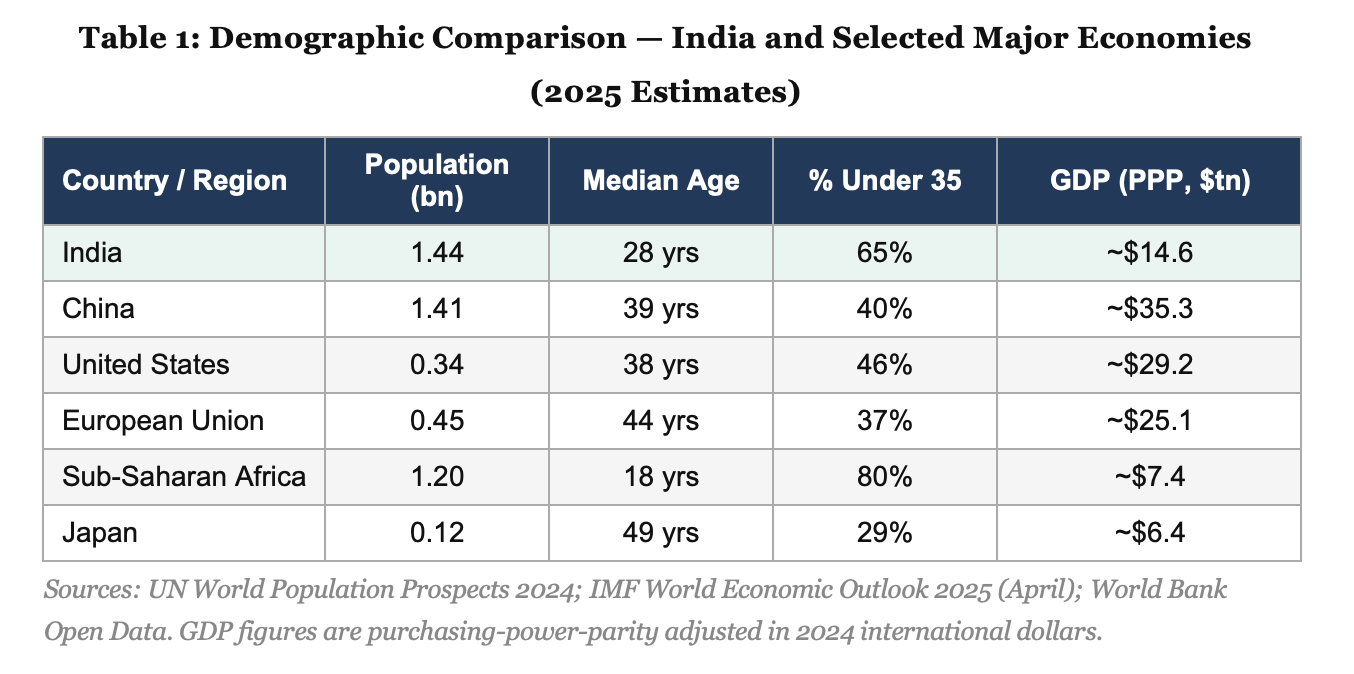
India became the world’s most populous nation in 2023, surpassing China with approximately 1.44 billion people. The structural character of India’s population, however, is as consequential as its scale. India’s median age in 2025 is approximately 28 years, compared to China’s 39 years, the European Union’s 44 years, and Japan’s 49 years. With 65% of its population below the age of 35 and over 600 million people below 25, India possesses a demographic profile that will generate a labour force dividend of historic proportions through at least 2045 — what economists term the ‘demographic sweet spot’ of high working-age population share and low dependency ratios.
The geopolitical implications of this demographic advantage are multi-dimensional. First, India will contribute more net additions to the global labour force over the next two decades than any other economy — an estimated 7-8 million new workers annually. In a world where the major economies of Europe, East Asia, and North America face acute labour shortages driven by ageing populations, India’s young workforce represents a global resource of the first order. Second, a young population is an innovation-intensive population: India’s 1.5 million annual engineering and technology graduates, its eight institutions in the global top 200 by research output, and its rapidly expanding startup ecosystem — now the third-largest globally by count — are direct products of this demographic dividend. Third, a young population creates domestic demand: India’s consumer market is projected to become the world’s third-largest by 2030, with implications for global supply chains, service trade, and investment flows.
5.2 Economic Trajectory: The Third Pole
India’s economic trajectory over the past decade has been remarkable by any comparative metric. Growing at an average of 6.5–7% annually since 2014 — the fastest rate among major economies, overtaking China consistently from 2022 onwards — India surpassed the United Kingdom as the world’s fifth-largest economy (nominal GDP) in 2022, is projected to overtake Japan and Germany to become the third-largest economy by 2027–2028, and is on track to reach a $10 trillion nominal economy by 2032. On purchasing power parity terms, India is already the world’s third-largest economy.
The structural drivers of this growth are distinctive. Unlike the East Asian growth model, which relied primarily on export-led manufacturing, India’s growth model has been services-led and domestically-demand-driven, making it more resilient to global trade disruptions. India’s digital public infrastructure — Aadhaar (the world’s largest biometric identity system), UPI (the world’s most successful real-time payments architecture, processing 14 billion transactions monthly in 2024), and DigiLocker — represents a globally replicable model for inclusive digital governance that 80+ nations are now seeking to adopt. The G20 India Presidency successfully internationalised this ‘DPI model,’ embedding it in the G20’s development architecture and positioning India as the world’s digital infrastructure exporter of first resort for the Global South.
India’s economic weight translates directly into geopolitical influence in the transitional moment. As the world’s fastest-growing major consumer market, India has increasing structural leverage over supply-chain decisions by multinational corporations seeking to reduce their China exposure — the ‘China+1’ strategy that has accelerated since 2020. Apple’s decision to manufacture 25% of its iPhones in India by 2025, Samsung’s expansion of its Noida facility, and the establishment of semiconductor assembly operations by multiple Taiwanese firms represent early manifestations of a supply-chain reorientation that will systematically enhance India’s economic and political leverage over the decade ahead.
5.3 Strategic Multi-Alignment: The Architecture of Swing-State Diplomacy
India’s simultaneous membership in the Quad (with the US, Japan, and Australia), BRICS+ (with China, Russia, Brazil, and the Global South), the Shanghai Cooperation Organisation, the G20, and its founding membership of the Non-Aligned Movement’s successor frameworks positions it as the world’s pre-eminent swing state — a nation that no major grouping can afford to lose and no single power can expect to capture. This is not the ‘non-alignment’ of Cold War neutralism, which was ultimately a form of passive balancing. It is what External Affairs Minister S. Jaishankar has described as strategic autonomy: the deliberate cultivation of relationships across competing power centres to maximise India’s freedom of action and value to all parties.
The practical manifestation of this strategic architecture has been India’s conduct in the Ukraine conflict. Refusing to condemn Russia while maintaining its principled commitment to the UN Charter’s prohibition on territorial conquest, importing discounted Russian hydrocarbons to protect its development budget, and simultaneously maintaining its Quad partnerships and its transatlantic relationships, India demonstrated that a major power could navigate the most polarising geopolitical crisis of the decade without being conscripted into either camp. Prime Minister Modi’s direct personal diplomacy — meeting both Putin and Zelensky in 2024, delivering the message that ‘this is not the era of war’ to both — was an exercise in principled engagement that no other major power has matched.
VI. India Leading the Global South: From Aspiration to Architecture
6.1 The Voice of the Global South Initiative
India’s launch of the Voice of the Global South Summit in January 2023 — convening 125 developing nations in a virtual format — was a structurally significant act. For the first time, a major power sought to aggregate the preferences of the Global South not as a bloc within existing Western-led institutions but as an independent agenda-setting exercise. The summit produced a coherent set of priorities: debt relief and restructuring, technology transfer, climate finance, reform of international institutions, and an end to the selective application of international law. These priorities were subsequently reflected in India’s G20 presidency agenda, giving them unprecedented institutional weight.
The initiative represents a model for India’s leadership architecture: not the formation of an anti-Western coalition but the construction of a Global South common position that can then be inserted into existing multilateral forums with the credibility of democratic legitimacy and the weight of India’s economic and diplomatic capital. This distinguishes India’s approach from China’s, which has sought to build parallel institutions (the Asian Infrastructure Investment Bank, the Belt and Road Initiative, BRICS Pay) as alternatives to Western-led architecture, and from Russia’s, which has sought to delegitimise the existing order without articulating a coherent alternative.
6.2 The New Development Bank and Development Finance Architecture
India’s participation in the New Development Bank — as both founder and, under the former Dilma Rousseff presidency, a major recipient and increasingly a governance stakeholder — positions it as a central player in the construction of development finance alternatives to the World Bank and IMF. The NDB model has demonstrated that infrastructure financing can be provided at scale without the political conditionality that has generated such widespread Global South resentment of the Bretton Woods institutions.
India should leverage its NDB position to advocate for three structural reforms: expanded capitalisation to reach $100 billion in annual lending capacity; the development of a local currency lending facility that reduces developing nations’ exposure to dollar-denominated debt service; and the creation of a Climate Resilience Window that channels the loss-and-damage finance commitments made at COP28 through the NDB rather than through Western-controlled climate funds. These reforms would simultaneously expand the NDB’s developmental impact and institutionalise India’s leadership of the development finance architecture.
6.3 Digital Public Infrastructure as Global Commons
India’s Digital Public Infrastructure stack — Aadhaar, UPI, ONDC, DigiLocker, the Account Aggregator framework — represents perhaps its most globally exportable governance innovation. The India Stack model has demonstrated that digital identity, payments, and data-sharing infrastructure can be built as open, interoperable public goods rather than proprietary corporate platforms, with transformative consequences for financial inclusion, government service delivery, and economic formalisation.
The G20 New Delhi Declaration’s endorsement of the DPI model as a global development framework — negotiated by India’s G20 Sherpa team against significant initial resistance from both the US (concerned about government-led digital infrastructure) and China (which preferred its own proprietary model) — represents a significant normative victory. India should now establish a DPI Technical Assistance Fund within the NDB or the UNDP, staffed by Indian technologists and policy experts, to support developing nations in implementing their own DPI ecosystems. This would create a new form of South-South cooperation grounded in genuine technological generosity rather than the extractive infrastructure model of Chinese BRI lending.
VII. Decisive Policy Choices in the Interregnum
This section identifies the policy choices that will determine whether India’s transitional moment becomes a sustained structural leadership position or dissipates into rhetorical multilateralism. These choices are not merely diplomatic tactics; they are architectonic decisions about the kind of international order India wishes to inhabit and the kind of power it wishes to be.
7.1 UNSC Reform: India’s Existential Multilateral Campaign
India’s campaign for a permanent seat in a reformed UN Security Council has been episodic and insufficiently resourced. The G4 initiative (India, Brazil, Germany, Japan) has produced diplomatic activity but no institutional change. This must change. India should elevate UNSC reform to the highest level of its foreign policy agenda, treating it as the single most important structural goal of the transitional decade.
The strategic case is straightforward: a UNSC without India is not merely unrepresentative; it is structurally dysfunctional. The second-most-populous nation on earth, the world’s third-largest economy (PPP), the largest contributor to UN peacekeeping operations, and the geographic centre of the Indo-Pacific security system has no permanent voice in the organ responsible for international peace and security. India should propose a concrete reform package — six new permanent members (India, Brazil, Germany, Japan, Nigeria, and an Arab League nominee) with a five-year moratorium on the veto for new members — and mobilise the two-thirds General Assembly majority required for the Charter amendment. The African Union’s Ezulwini Consensus (demanding two permanent African seats) and the Arab League’s reform demands should be actively incorporated into India’s coalition-building strategy.
7.2 Ukraine: Institutionalising India’s Mediation Role
India’s neutrality on Ukraine has been widely noted but insufficiently institutionalised. The time for passive neutrality has passed; the time for active mediation has arrived. India should convene, under its own auspices, a ‘Contact Group for Ukraine Dialogue’ — a structured multilateral process that brings together Russia, Ukraine, the EU, China, Brazil, and Turkey in a format that neither NATO nor the Shanghai Cooperation Organisation can provide. India’s unique position as a nation trusted by Moscow (for its continued engagement), respected by Kyiv (for Modi’s direct messages on the illegitimacy of territorial conquest), and accepted by Washington (as a Quad partner) makes it the only major power with the relational capital to convene such a process.
The diplomatic template exists: the Minsk process, the Oslo process, the Camp David framework. India needs to provide its own template — the ‘Delhi Process’ — one that is grounded in the UN Charter’s principles (territorial integrity, sovereign equality, prohibition on the use of force) while being sufficiently flexible to accommodate the security concerns of all parties. This is precisely the kind of principled multilateralism that Carney’s ‘Third Path’ framework anticipates and that India is structurally positioned to provide.
7.3 Gaza and the Middle East: Ending Strategic Ambiguity
India’s position on the Palestinian question has historically been clear: it was among the first non-Arab nations to recognise the Palestine Liberation Organisation, established full diplomatic relations with the State of Palestine in 1988, and has consistently supported Palestinian statehood in UN forums. However, the deepening of India-Israel defence and technology relations since 2014 has introduced a strategic ambiguity that has significantly damaged India’s credibility with the Arab world and the Global South.
The humanitarian catastrophe in Gaza since October 2023 — over 46,000 dead, the ICJ finding of a plausible risk of genocide, the ICC arrest warrants for both Hamas leaders and the Israeli Prime Minister — has made this ambiguity untenable. India must make a decisive choice: it can maintain its defence-industrial relationship with Israel while clearly and publicly supporting ICJ and ICC processes, conditioning any further arms exports on compliance with international humanitarian law, and co-sponsoring a UN General Assembly resolution demanding an immediate ceasefire and the commencement of a genuine two-state political process. This is not an anti-Israel position; it is a pro-international-law position consistent with India’s foundational multilateral commitments. The Arab states that are now full BRICS members — the UAE, Saudi Arabia, Egypt — are watching India’s conduct on this question with great attention.
7.4 Afghanistan: Conditionality as Principle
India’s engagement with the Taliban-controlled Afghan government has been driven by legitimate strategic interests: preventing Pakistan from establishing exclusive influence over Kabul, protecting Indian infrastructure investments in Afghanistan, and maintaining a strategic presence on Pakistan’s western flank. However, engagement without conditionality has carried a significant normative cost: India’s silence on the Taliban’s systematic erasure of women from Afghan public life — the most comprehensive gender apartheid on the planet — contradicts its self-presentation as a champion of human dignity.
India should work within the Shanghai Cooperation Organisation — of which it is a full member alongside China, Russia, Pakistan, and several Central Asian states — to develop a multilateral conditionality framework for Taliban engagement: access to development finance, trade facilitation, and political recognition conditioned on measurable improvements in girls’ education and women’s public participation. This is an instance where India’s democratic values and its strategic interests can be reconciled — the SCO framework provides the multilateral cover that prevents the conditionality from being characterised as Western imperialism.
7.5 Latin America: Completing the South-South Triangle
India’s engagement with Latin America remains its most underdeveloped major-region diplomatic relationship. The continent’s 650 million people, its abundant natural resources (including 40% of global lithium reserves, critical for the energy transition), its democratic traditions, and its growing disenchantment with both Washington’s hegemonic presumptions and Beijing’s debt-laden infrastructure model create a structural opportunity for India that has been only partially seized.
India should launch a ‘Latin America Digital Partnership’ — offering its DPI stack, pharmaceutical generics access (India supplies 40% of the world’s generic medicines), and IT services expertise as a South-South cooperation framework. On the political dimension, India should signal clear democratic solidarity: supporting free and fair elections, declining to provide legitimacy to extra-constitutional power transfers, and advocating within BRICS+ for the adoption of a democratic governance norm applicable to all members. This is a delicate balance — BRICS includes Venezuela and Cuba — but India’s democratic credentials give it the standing to make this argument in a way that no other BRICS member can.
7.6 Climate Leadership: The Development-Transition Compact
India’s position on climate change is the most consequential of its global policy choices for the simple reason that India is simultaneously the world’s third-largest emitter of greenhouse gases (by total volume), one of the most climate-vulnerable major economies, and the most important swing-state in any global climate agreement. India’s National Determined Contributions under the Paris Agreement — targeting 500GW of renewable energy by 2030, 50% of electricity from non-fossil sources by 2030, and net-zero by 2070 — are credible, measurable, and being executed ahead of schedule.
India should leverage this credibility to lead the Global South in negotiating a new Climate-Development Compact: a framework that links developed-world loss-and-damage payments and technology transfer commitments to enhanced NDC ambition by developing nations. This is the essential bargain that has eluded successive COP summits. India, as the nation that simultaneously represents the development aspirations of the Global South and the renewable-energy ambitions of the major emerging economies, is uniquely positioned to broker it. The creation of a G20 ‘Climate Development Financing Facility’ — proposed by India at the Rio summit — should be India’s signature multilateral initiative for 2026–2027.
VIII. Conclusion: The Civilisational Moment
The argument of this paper can be stated with some parsimony. The post-1945 international order is experiencing a structural rupture driven by the convergence of American unilateralism, great-power revisionism, the assertion of the Global South, and the institutional paralysis of multilateral architecture. The emerging multipolar order requires new institutional architecture, new normative foundations, and new political leadership to prevent the interregnum from generating systemic disorder. India — uniquely among the major powers of the transitional moment — possesses the combination of structural advantages required to provide this leadership: the demographic dividend of a young, growing, innovative population; the economic trajectory of the world’s fastest-growing major economy; the civilisational resources of a philosophy of interdependence and relational governance; the democratic credentials that no other major non-Western power can claim; and the strategic positioning of a swing state trusted by all camps.
India’s task is not to replicate the Western model of hegemonic leadership — imposing its preferences through coercion and selective rule enforcement. Its task is to operationalise a different model: the model of civilisational multilateralism, in which power is used not to dominate but to convene; in which institutions are built not to advantage their architects but to genuinely serve their members; and in which the normative foundations of international order are derived not from the strategic preferences of the powerful but from the universal requirements of human dignity, sovereign equality, and collective security.
This is an ambitious vision. It is also a necessary one. The alternative — a world of competing blocs, weaponised interdependence, and institutional paralysis in the face of climate change, pandemic risk, nuclear proliferation, and AI-enabled conflict — carries catastrophic consequences for all of humanity, and disproportionately catastrophic consequences for the developing world. India has a civilisational memory of what it means to be subject to hegemonic power and the practical wisdom that comes from having governed diversity at continental scale for millennia. It is, in the fullest sense of the phrase, the moment India was made for.
References
Acharya, A. (2014). The End of American World Order. Polity Press.
Allison, G. (2017). Destined for War: Can America and China Escape Thucydides’s Trap? Houghton Mifflin Harcourt.
Beri, R. & Bhatt, V. (2024). India’s G20 Presidency: The Global South Agenda. IDSA Occasional Paper No. 74.
Buzan, B. & Lawson, G. (2015). The Global Transformation: History, Modernity and the Making of International Relations. Cambridge University Press.
Carney, M. (2026). Address to the World Economic Forum Annual Meeting. Davos, Switzerland, 20 January 2026. Official transcript, Office of the Prime Minister of Canada.
Carnegie Endowment for International Peace. (2025). BRICS+: Strategic Ambitions and Structural Constraints. Carnegie Working Paper Series.
Ikenberry, G. J. (2011). Liberal Leviathan: The Origins, Crisis, and Transformation of the American World Order. Princeton University Press.
IMF (2025). World Economic Outlook, April 2025. International Monetary Fund, Washington DC.
Jaishankar, S. (2020). The India Way: Strategies for an Uncertain World. HarperCollins India.
Mearsheimer, J. J. (2001). The Tragedy of Great Power Politics. W.W. Norton.
Ministry of External Affairs, Government of India. (2023). Voice of the Global South Summit Outcome Document. New Delhi: MEA Publications.
Organski, A.F.K. (1958). World Politics. Alfred A. Knopf.
Pant, H. V. & Sahu, D. (2025). India’s Strategic Autonomy in the Age of Multipolarity. Observer Research Foundation Strategic Studies, Vol. 12.
Reus-Smit, C. (2004). American Power and World Order. Polity Press.
Sharma, R. (2024). The India Way: Demographic Dividend and the Geopolitics of Growth. Brookings India Research Paper Series.
UN Department of Economic and Social Affairs. (2024). World Population Prospects 2024. United Nations, New York.
UN General Assembly. (2005). 2005 World Summit Outcome Document. A/RES/60/1. United Nations, New York.
World Bank. (2025). Global Economic Prospects, January 2025. World Bank Group, Washington DC.
Disclaimer: This paper reflects the independent scholarly views of the author and does not represent the position BRICS Institute as a whole.
