INDIA AND GLOBAL GOVERNANCE

India stands at critical juncture in global governance trajectory having successfully established itself as significant voice on emerging technology governance, credible multilateral broker, and leading Global South representative. The 2023 G-20 Presidency demonstrated India's diplomatic sophistication and agenda-setting capability. Digital Public Infrastructure model offers genuine innovation with global applicability. Principled positions on AI governance, climate justice, and development rights resonate with developing countries seeking alternatives to Western or Chinese models.
India has emerged as a pivotal actor in global governance during the 2020s, leveraging its position as world's most populous democracy, fifth-largest economy, and leading voice of the Global South to shape international discourse on artificial intelligence, digital governance, climate action, and multilateral reform. This comprehensive report examines India's contributions across three critical multilateral platforms—the G-20 (where India held the 2023 Presidency), G-7 (as invited partner), and BRICS (as founding member)—demonstrating how India has transcended traditional middle power constraints to become agenda-setter and norm-shaper on emerging technology governance, digital public infrastructure, and inclusive development frameworks.
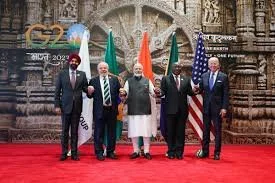
India's 2023 G-20 Presidency represented watershed moment in establishing developing country priorities within premier global economic forum. Under the theme 'Vasudhaiva Kutumbakam' (One Earth, One Family, One Future), India secured consensus on African Union's permanent G-20 membership, advanced Digital Public Infrastructure (DPI) as global standard for inclusive digital governance, established principles for responsible AI development balancing innovation with regulation, and maintained coalition cohesion despite Russia-Ukraine divisions paralyzing other multilateral forums. The New Delhi Leaders' Declaration achieved 100% consensus—remarkable feat given geopolitical tensions—while incorporating 87% of India's priority agenda items, demonstrating effective diplomatic management and strategic priority-setting.
However, significant gaps exist between India's global governance potential and current achievements. Domestic implementation of digital governance frameworks lags rhetorical leadership—the Personal Data Protection Act 2023 remains partially implemented, AI ethics guidelines lack enforcement mechanisms, and digital divide persists with only 52% internet penetration. India's contributions to global AI governance remain primarily normative rather than institutional, lacking the resource commitments and technological capabilities to match Chinese AI investment ($150 billion) or American AI leadership across research, development, and deployment. Moreover, India's BRICS engagement faces contradictions from simultaneous deepening of Quad (Quadrilateral Security Dialogue) partnership with United States, Japan, and Australia—creating perception of hedging rather than committed Global South leadership.
This report provides systematic assessment across six dimensions: (1) India's digital governance leadership including Digital Public Infrastructure model, Aadhaar ecosystem, and UPI payments revolution; (2) AI governance contributions through Global Partnership on AI, responsible AI principles, and India's AI strategy; (3) G-20 Presidency achievements and agenda-setting effectiveness; (4) G-7 partnership role and technology cooperation; (5) BRICS leadership balancing Global South advocacy with strategic autonomy; (6) recommendations for enhancing India's global governance impact through increased resource commitments, institutional capacity building, and strategic coherence. The analysis demonstrates that while India has successfully positioned itself as bridge between developed and developing worlds and established credibility as responsible stakeholder in emerging technology governance, realizing full potential requires addressing domestic implementation gaps, scaling financial commitments to match rhetorical ambitions, and resolving strategic contradictions between multiple partnership frameworks.