

Growing Old Before Growing Rich
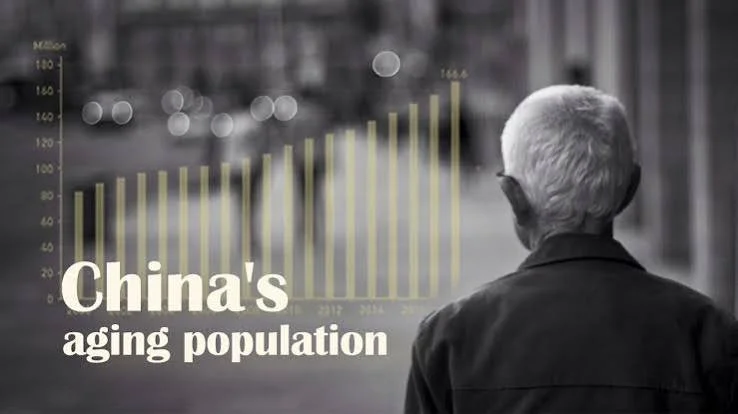
China’s aging poplation
China's ageing is a measurable drag on its economy, and the way it responds will decide whether it escapes the middle-income trap. In 2025, China recorded 7.92 million births against 11.31 million deaths, and its population fell by 3.39 million to about 1.405 billion. Births were less than half the number of a decade earlier. By raw numbers, it was the steepest annual fall in population since the famine of 1959–61. This was the fourth consecutive year of decline. UN projections place the share over 65 at 28.9%, and the median age at 51.9, by 2046. The question is what this does to growth and income, and whether policy can prevent stagnation just below the high-income line.
latest research reports led by World Bank and IMF vindicates our observation that a precise that China is ageing before becoming rich. It does not support a claim that China is poor or doomed: it is close to the World Bank’s high-income line.On the World Bank's measure, China is almost a high-income economy. Its gross national income per person was $14,230, just under the $14,375 threshold. Crossing it is likely within a year or two. This is why the "middle-income trap" needs careful definition. It does support the view that China will bear the fiscal and growth costs of an older society at a lower level of productivity than Japan.
So, China is within about 1% of the World Bank’s high-income threshold, so it is likely to cross it soon (Our World in Data, 2026). The trap described in the World Development Report 2024, a stall at about 10% of US income, lies far behind China (World Bank, 2024). The relevant risk is a later stagnation: growth falling towards 4% or lower while the workforce shrinks, leaving China short of the productivity of advanced economies. lets discuss some details below.
How ageing slows growth
Ageing acts through several channels. The first is labour supply. A smaller working-age population means fewer workers and, unless productivity rises faster, slower output growth. The IMF's staff report on China says the 2025 increase in the retirement age will only partially mitigate the expected decline in the labour force, with ageing and decreasing returns to investment remaining significant headwinds to potential growth. The IMF's Executive Board projects growth to slow to 4.5 percent in 2026 and to keep decelerating over the medium term because of a declining labour force, decreasing returns to investment and slower productivity growth. The World Bank sees the same direction: it expects 4.5% growth in 2026, citing an ageing population, high debt and diminishing returns on capital as medium-term weights.
The second channel is public finance. An IMF working paper using a calibrated model estimates that ageing alone could slow annual GDP growth by about 2 percentage points between 2024 and 2050, while pension spending could rise by nearly 10 percentage points of GDP. The 2024 retirement-age reform raises growth by 0.2 percentage points a year and cuts 2050 pension spending from 15.3 to 11.9 percent of GDP. That is a meaningful offset, but it covers only a share of the burden.
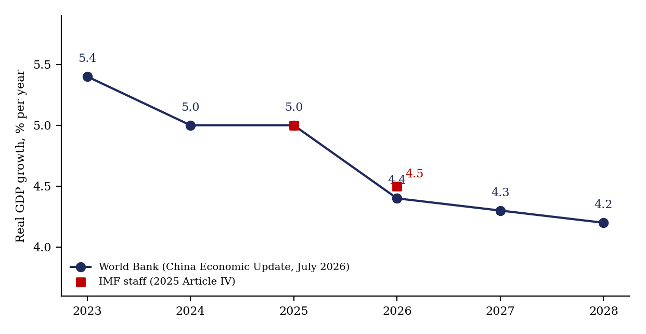
Figure 1. Real GDP growth in China, World Bank series and IMF projections
Note. Sources: World Bank (2026) for 2023–2028; IMF (2026b) for 2025–2026. The October 2026 World Bank update raised its 2026 forecast to 4.5% (ICIS, 2026).
Old by the numbers
The official statistics show a society ageing at record speed. More than 323 million Chinese, about 23% of the population, are over 60, and nearly 16% are over 65. The working-age population (16–59) stands at about 851 million. The worst may be ahead. Annual deaths are expected to rise toward 15 million by 2035. Official figures put the fertility rate at about 1.1 in 2024, and one report puts it at 0.96 in 2025. Either figure is far below the 2.1 needed to keep a population stable.
China’s population has fallen for four consecutive years, and official and international projections point to a much older society by the mid-2040s. Chinese demographers had long warned that the country would grow old before it grew rich. In 2026, that warning has become a description. On IMF and World Bank evidence, China is ageing before becoming rich in a comparative sense, even though it is close to the World Bank’s high-income threshold. The strongest findings concern the fiscal burden and growth drag: ageing alone could lower annual growth by about 2 percentage points and raise pension spending by nearly 10 percentage points of GDP by 2050, and the retirement-age reform offsets only part of it. The decisive variables are productivity growth, pension design and, to a lesser extent, fertility.
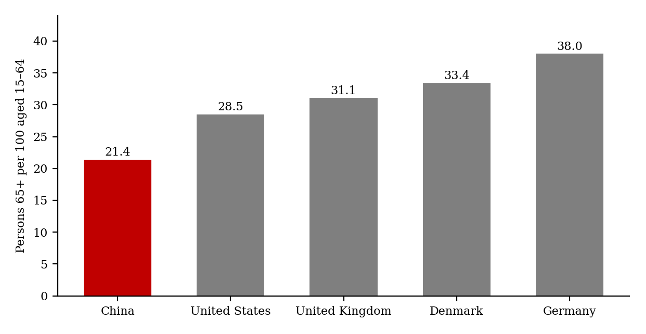
Figure 2. Old-age dependency ratio, selected countries
Note. Persons aged 65+ per 100 aged 15–64. Source: WDI as compiled by Georank (2026).
China’s fertility rate, about 1.0 in the WDI series, is among the lowest in the world, and births in 2025 were 17% below the previous year (Caixin Global, 2026; UPI, 2026). Deaths are projected to rise towards 15 million a year by 2035 (Rhodium Group, 2026). UN projections place China’s 65+ share at 28.9% and its median age at 51.9 years by 2046 (PopulationPyramid.net, 2024). Figure 1 shows that China’s current old-age dependency ratio (21.4%) remains well below those of the United States, United Kingdom, Denmark and Germany, so the main burden lies ahead.
Reasons for caution and optimism
The World Bank's 2024 World Development Report finds that as countries grow richer they usually hit a trap at about 10% of US income per person, roughly $8,000 today, and that only 34 middle-income economies have become high-income since 1990, more than a third of them through EU integration or oil. China is well past that early trap point. The risk it faces is the later one: growing at 4% or less while its workforce shrinks, and stalling before reaching the income and productivity levels of advanced economies.
There is one case for optimism that is Automation. Automation may turn a labour shortage into a productivity gain (Acemoglu & Restrepo, 2017). Against that, both the IMF and the World Bank forecast slowing growth, and the property downturn and weak consumption show that the transition away from investment-led growth is difficult (ICIS, 2026; IMF, 2026a). The most defensible conclusion is that outcomes depend on policy: the same demography can yield stagnation or a successful transition to an innovation-led economy.
Many countries have aged before becoming rich, and some have still reached high-income status, so ageing is a constraint, not a verdict. China also starts from a position of strong investment capacity, a large domestic market and growing technological strength. The case for caution is that the IMF and World Bank both forecast slowing growth, and demographic arithmetic is difficult to change quickly.
My conclusion is that the greatest danger is not crossing the $14,375 line, which China is likely to do. It is arriving there with weak productivity, an under-funded pension system and high savings that hold back consumption. Escaping the trap means treating ageing as a reason to raise output per worker rather than only to raise the worker count. China's position is unusual in one respect. Its productivity is much lower than that of high-income countries, even though its research spending compares well with many European economies.
Avoiding the trap therefore requires treating ageing as a reason to raise output per worker: improving the return on investment, diffusing technology, innovating and automating, reforming pensions and labour markets, and rebalancing demand (also recommended by World Bank 2026).
References
Acemoglu, D., & Restrepo, P. (2017). Secular stagnation? The effect of aging on economic growth in the age of automation. American Economic Review, 107(5), 174–179.
Bloom, D. E., Canning, D., & Fink, G. (2010). Implications of population ageing for economic growth. Oxford Review of Economic Policy, 26(4), 583–612.
Bloom, D. E., & Williamson, J. G. (1998). Demographic transitions and economic miracles in emerging Asia. The World Bank Economic Review, 12(3), 419–455.
BOFIT. (2025, August). China introduces nationwide childcare subsidy and free pre-school education. BOFIT Weekly Review 32/2025. https://www.bofit.fi/en/monitoring/weekly/2025/vw202532_2/
Bonthuis, B., Cao, Y., & Freudenberg, C. (2026). Population aging and pension reforms in China (IMF Working Paper No. 2026/027). International Monetary Fund. https://doi.org/10.5089/9798229038522.001
Caixin Global. (2026, January 19). China’s population decline accelerates as births hit modern-era low in 2025. https://www.caixinglobal.com/2026-01-19/chinas-population-decline-accelerates-as-births-hit-modern-era-low-in-2025-102405521.html
East Asia Forum. (2016, July 19). Can China get rich after getting old? https://eastasiaforum.org/2016/07/19/can-china-get-rich-after-getting-old/
Economy Middle East. (2024). ‘Middle-income trap’ hinders economic progress of 108 developing countries, says World Bank. https://economymiddleeast.com/news/middle-income-trap-hinders-economic-progress-of-108-developing-countries-says-world-bank
Eichengreen, B., Park, D., & Shin, K. (2014). Growth slowdowns redux. Japan and the World Economy, 32, 65–84.
Georank. (2026). China demographic data [Data compiled from World Bank and UN sources, retrieved July 8, 2026]. https://georank.org/demographics/china
Gill, I., & Kharas, H. (2007). An East Asian renaissance: Ideas for economic growth. World Bank.
ICIS. (2026, October 8). World Bank raises China 2026 GDP growth forecast to 4.5% on high-tech exports. https://www.icis.com/explore/resources/news/2026/10/08/11236427/world-bank-raises-china-2026-gdp-growth-forecast-to-4-5-on-high-tech-exports/
International Monetary Fund. (2026a). People’s Republic of China: 2025 Article IV consultation—Press release; staff report; and statement by the Executive Director for the People’s Republic of China (IMF Country Report No. 26/044). https://www.imf.org/en/publications/cr/issues/2026/02/17/peoples-republic-of-china-2025-article-iv-consultation-press-release-staff-report-and-574028
International Monetary Fund. (2026b, February 18). IMF Executive Board concludes 2025 Article IV consultation with China (Press Release No. 26/053). https://www.imf.org/en/news/articles/2026/02/18/pr-26053-china-imf-executive-board-concludes-2025-article-iv-consultation
Maestas, N., Mullen, K. J., & Powell, D. (2016). The effect of population aging on economic growth, the labor force and productivity (NBER Working Paper No. 22452). National Bureau of Economic Research.
Our World in Data. (2026). China only just missed the income cutoff to become a high-income country this year. https://ourworldindata.org/data-insights/china-only-just-missed-the-income-cutoff-to-become-a-high-income-country-this-year
Pension Policy International. (2026). China’s retirement wave is here: The pension math is brutal. https://www.pensionpolicyinternational.com/chinas-retirement-wave-is-here-the-pension-math-is-brutal/
PopulationPyramid.net. (2024). China population pyramid 2046 [UN World Population Prospects 2024 revision, medium variant]. https://www.populationpyramid.net/china/2046/
South China Morning Post. (2026, January). China’s demographic alarms blare as births hit historic low and population shrinks again. https://www.scmp.com/economy/china-economy/article/3340398/chinas-demographic-alarms-blare-births-hit-historic-low-and-population-shrinks-again
UPI. (2026, January 19). China’s population drops for fourth straight year. https://www.yahoo.com/news/articles/chinas-population-drops-fourth-straight-093456391.html
World Bank. (2024, August 1). “Middle-income trap” hinders progress in 108 developing countries [Press release on the World Development Report 2024: The Middle Income Trap]. https://www.worldbank.org/en/news/press-release/2024/07/22/middle-income-trap-hinders-progress-in-108-developing-countries
World Bank. (2026, July). China economic update—July 2026: Rebalancing growth. https://thedocs.worldbank.org/en/doc/0cb2fc6dd88d4db3816dc0433b5cb49b-0070012026/original/CEU-July-2026-EN.pdf
